
On this page
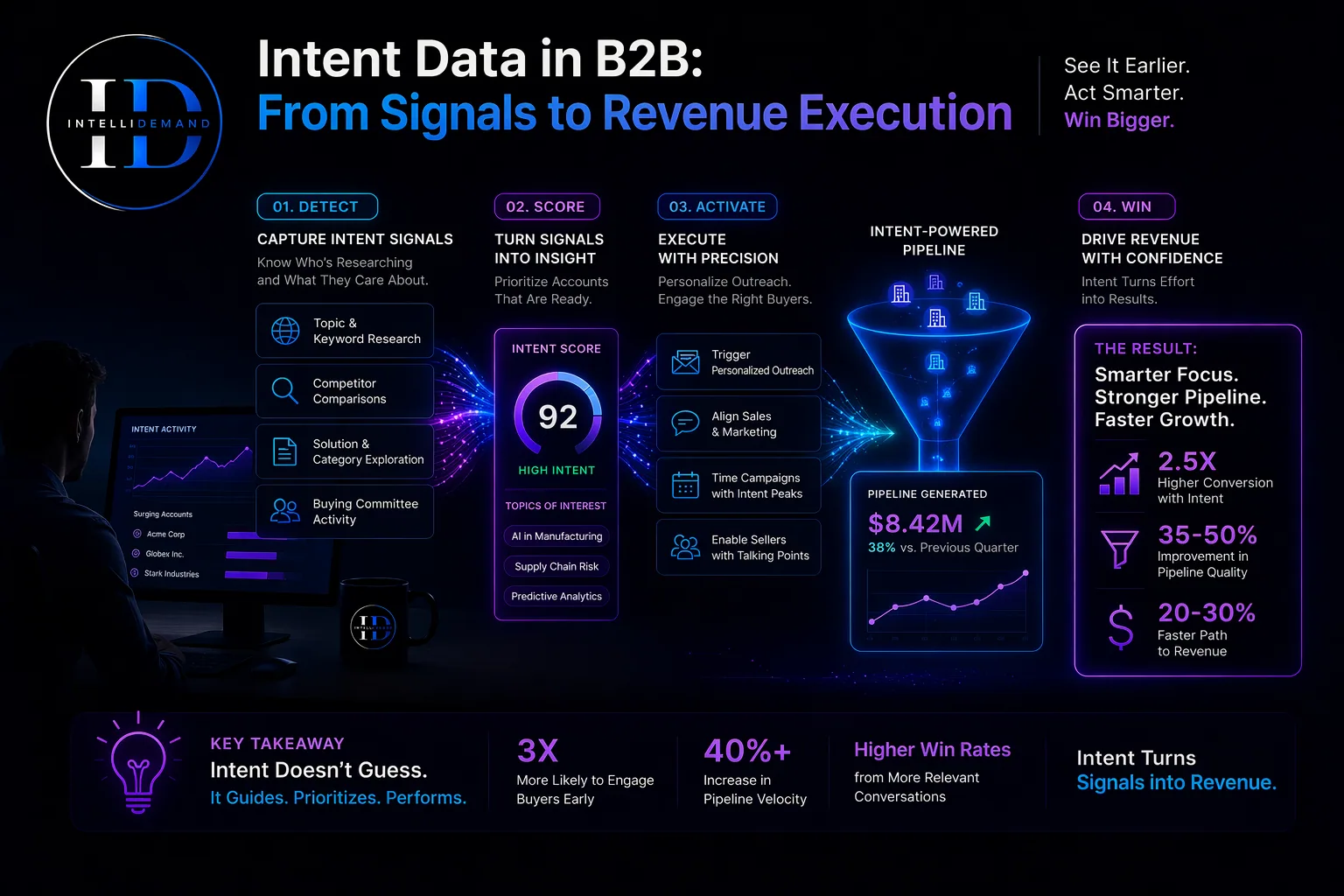
Intent data has become one of the most discussed concepts in modern B2B demand generation.
But discussion does not equal execution.
Many organizations subscribe to intent platforms, monitor spikes in activity, and generate reports filled with trending keywords — yet pipeline performance remains inconsistent.
The problem isn’t access to signals.
It’s activation discipline.
In 2026 and beyond, the companies winning pipeline are not those collecting intent data.
They are the ones operationalizing it into structured revenue systems.
Let’s break down what that actually means.
The Misconception: Intent Data Automatically Equals Pipeline
Intent signals indicate research behavior.
They do not guarantee:
- Budget approval
- Active initiative
- Buying authority
- Vendor readiness
Many demand teams make a costly mistake:
They treat research activity as purchase readiness.
This leads to:
- Premature outreach
- Generic messaging
- Inflated expectations
- Low conversion rates
Intent is a directional signal — not a closed opportunity.
Execution determines the outcome.
What Intent Data Really Represents
At its core, intent data measures:
- Topic-level content consumption
- Account research activity
- Comparative vendor exploration
- Industry trend engagement
But intent alone is incomplete.
It must be layered with:
- ICP alignment
- Technographic validation
- Organizational fit
- Stakeholder identification
- Historical engagement data
Intent without context is noise.
Intent with qualification becomes opportunity.
The 4 Stages of Intent Activation
High-performance demand teams do not react to signals.
They activate them through structure.
Signal Qualification
Not all spikes are equal.
Elite teams filter signals based on:
- Frequency and intensity
- Topic relevance
- Competitive research patterns
- Account tier prioritization
This ensures marketing resources are focused on high-probability accounts.
Buying Stage Mapping
Intent must align with stage.
Early-stage signals require:
- Educational content
- Industry insights
- Problem framing
Mid-stage signals require:
- Comparison guides
- Case studies
- ROI frameworks
Late-stage signals require:
- Executive validation
- Implementation clarity
- Decision acceleration assets
Intent activation without stage alignment reduces credibility.
Multi-Touch Orchestration
Once signals are validated and mapped, coordinated outreach begins.
This includes:
- Intent-aligned email messaging
- Account-based retargeting
- SDR contextual outreach
- Personalized content delivery
- Executive-level reinforcement
Every message reflects the research theme the account is already exploring.
This creates resonance.
Sales Intelligence Enablement
Intent signals are powerful in the hands of sales — when delivered properly.
High-performance teams provide sales with:
- Topic-specific research insights
- Stakeholder-level engagement data
- Timing indicators
- Competitive awareness signals
This improves:
- Discovery calls
- Objection handling
- Meeting-to-opportunity conversion
Intent becomes a conversation advantage.
Why Most Intent Programs Underperform
There are three common execution gaps.
Gap 1: Over-Automation
Automation without human interpretation creates irrelevant outreach at scale.
Signals must be validated before activation.
Gap 2: No Account Strategy
Intent is often activated at the contact level.
Enterprise buying requires account-level orchestration.
Without stakeholder mapping, momentum stalls.
Gap 3: No Feedback Loop
Intent activation must be continuously refined using:
- Sales feedback
- Opportunity progression
- Win-loss analysis
Without optimization, performance plateaus.
Intent as a Revenue Accelerator
When executed correctly, intent activation delivers measurable impact:
- Higher sales acceptance rates
- Increased meeting quality
- Faster pipeline velocity
- Improved opportunity conversion
- More predictable forecasting
Because intent shortens the distance between research and conversation.
It reduces cold outreach friction.
It increases relevance.
The Evolution: From Signals to Systems
In 2026, intent will not be a standalone tactic.
It will be integrated into:
- Account-based demand models
- Multi-touch architecture
- Qualification frameworks
- Revenue accountability metrics
Intent becomes part of pipeline infrastructure — not a marketing add-on.
What High-Performance Teams Do Differently
They don’t ask:
“How many intent accounts do we have?”
They ask:
“How many intent accounts converted into revenue-stage pipeline?”
They don’t measure activity.
They measure revenue movement.
They don’t react to spikes.
They design structured activation systems.
The Strategic Advantage of Early Signal Recognition
Early signal monitoring creates competitive leverage.
When activated properly, organizations can:
- Enter buying conversations earlier
- Shape vendor evaluation criteria
- Establish authority before competitors
- Influence budget conversations
Intent is not about chasing demand.
It’s about shaping it.
Final Thought
Intent data is powerful.
But power without structure creates inconsistency.
The future of B2B demand generation belongs to teams who:
Track signals.
Validate context.
Orchestrate engagement.
Align with sales.
Measure revenue impact.
Because intent alone does not create pipeline.
Execution does.
Keep reading
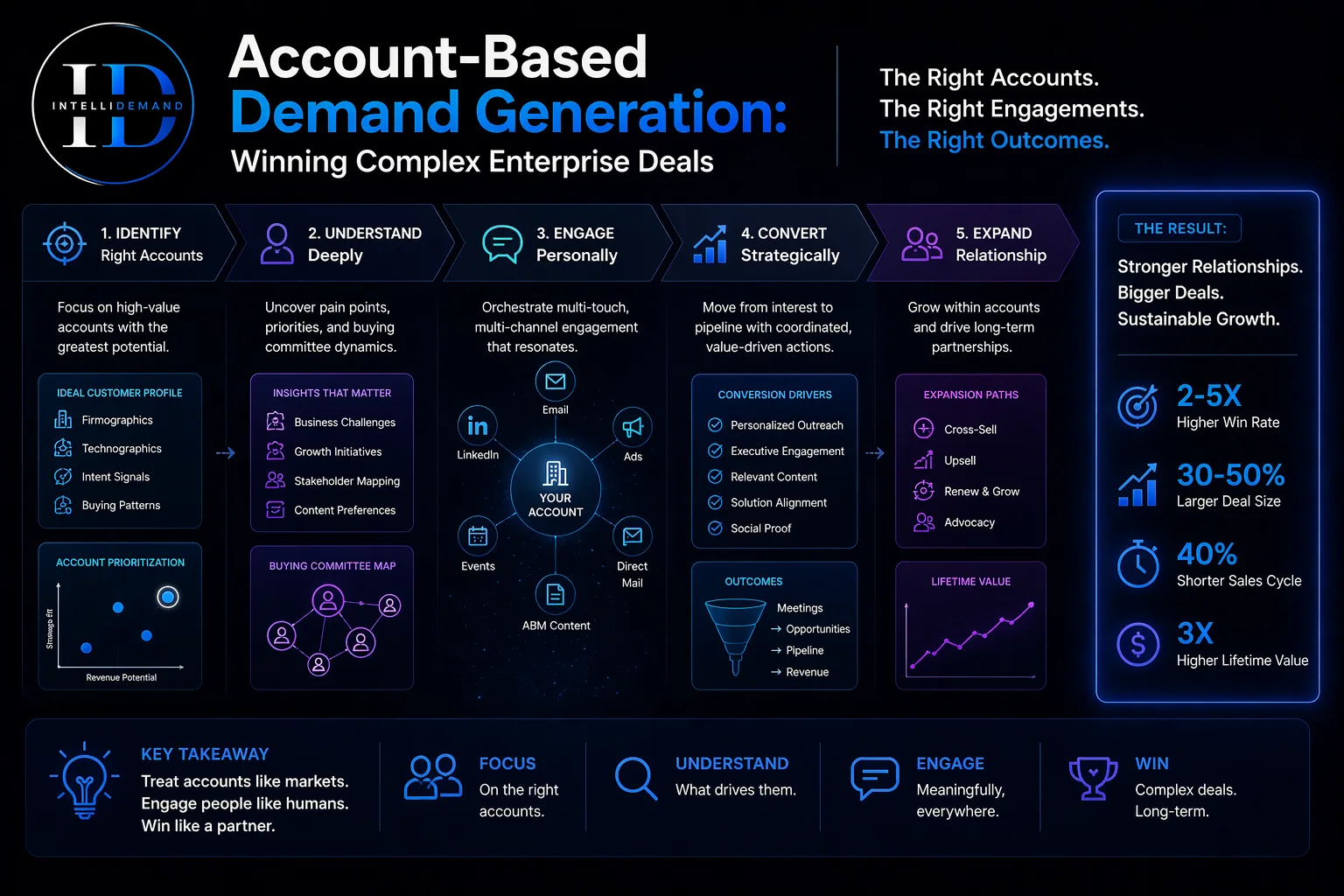
Account-Based Demand Generation: Winning Complex Enterprise Deals
Enterprise B2B sales are not won with broad campaigns. They are won with precision.
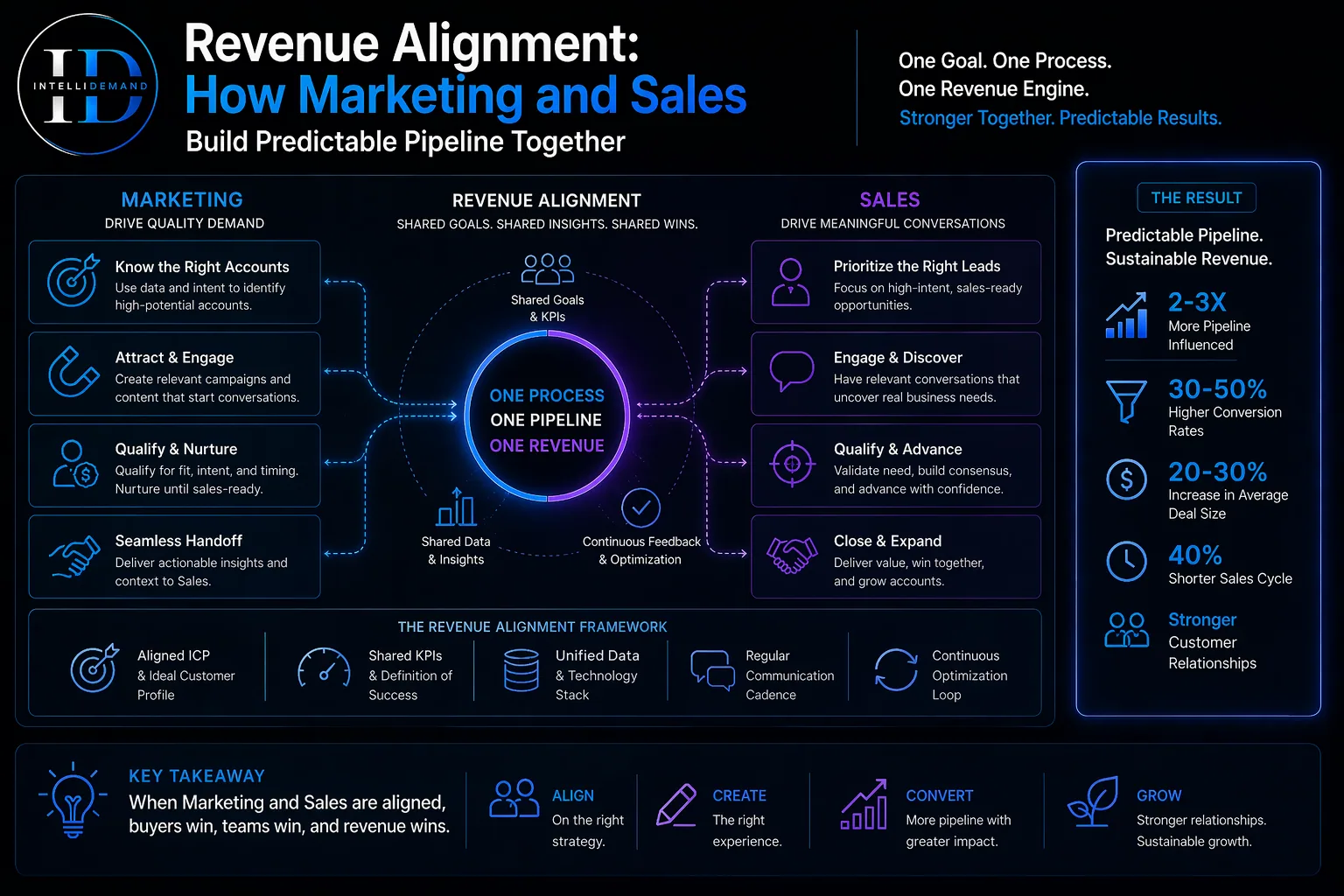
Revenue Alignment: How Marketing and Sales Build Predictable Pipeline Together
In high-performing B2B organizations, marketing and sales are not separate departments. They are revenue partners.
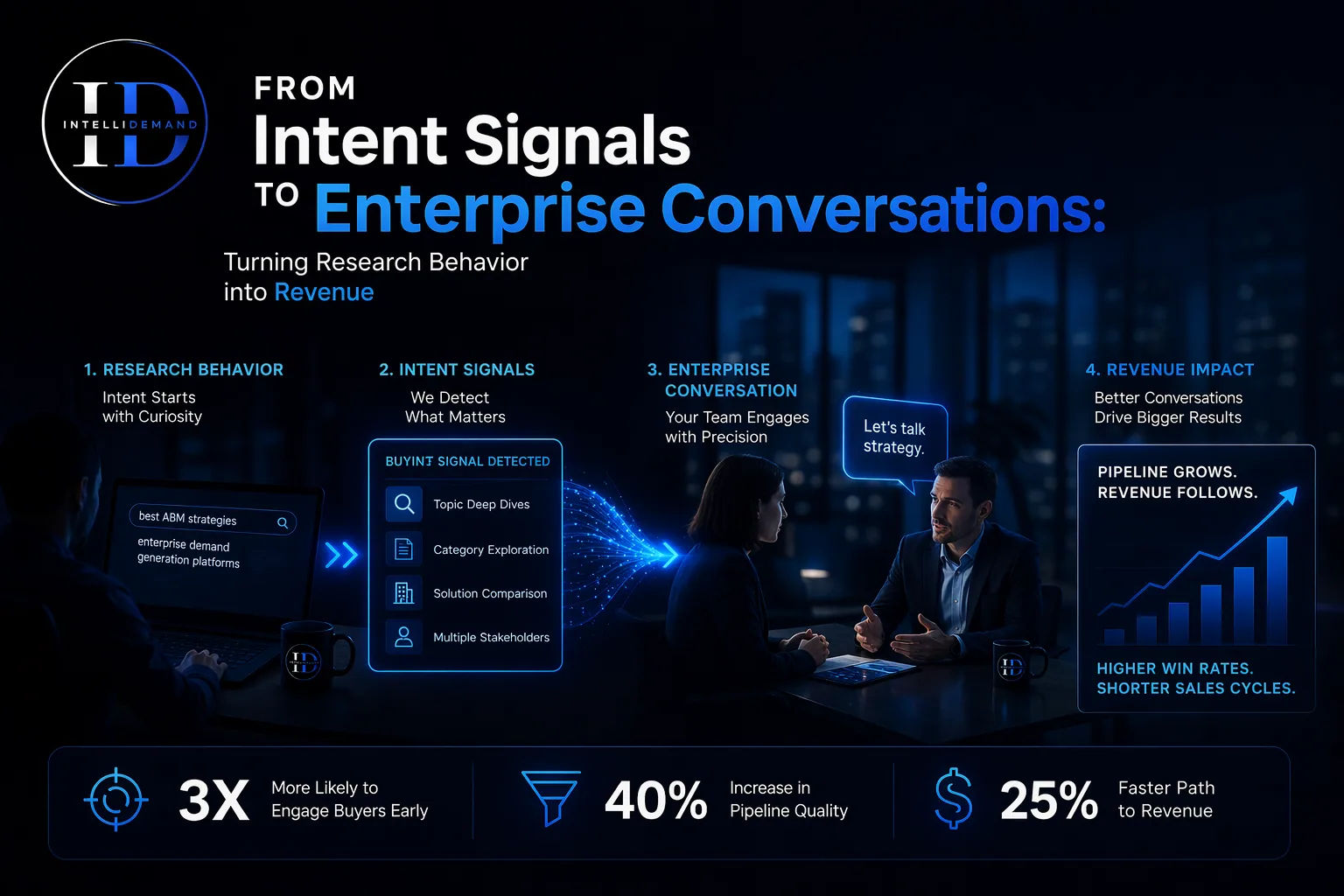
From Intent Signals to Enterprise Conversations: Turning Research Behavior into Revenue
Intent data is everywhere. But revenue impact is not.
Get demand-generation insights in your inbox
Practical B2B pipeline, ABM and content syndication ideas from the IntelliDemand team. No spam, unsubscribe anytime.