
On this page
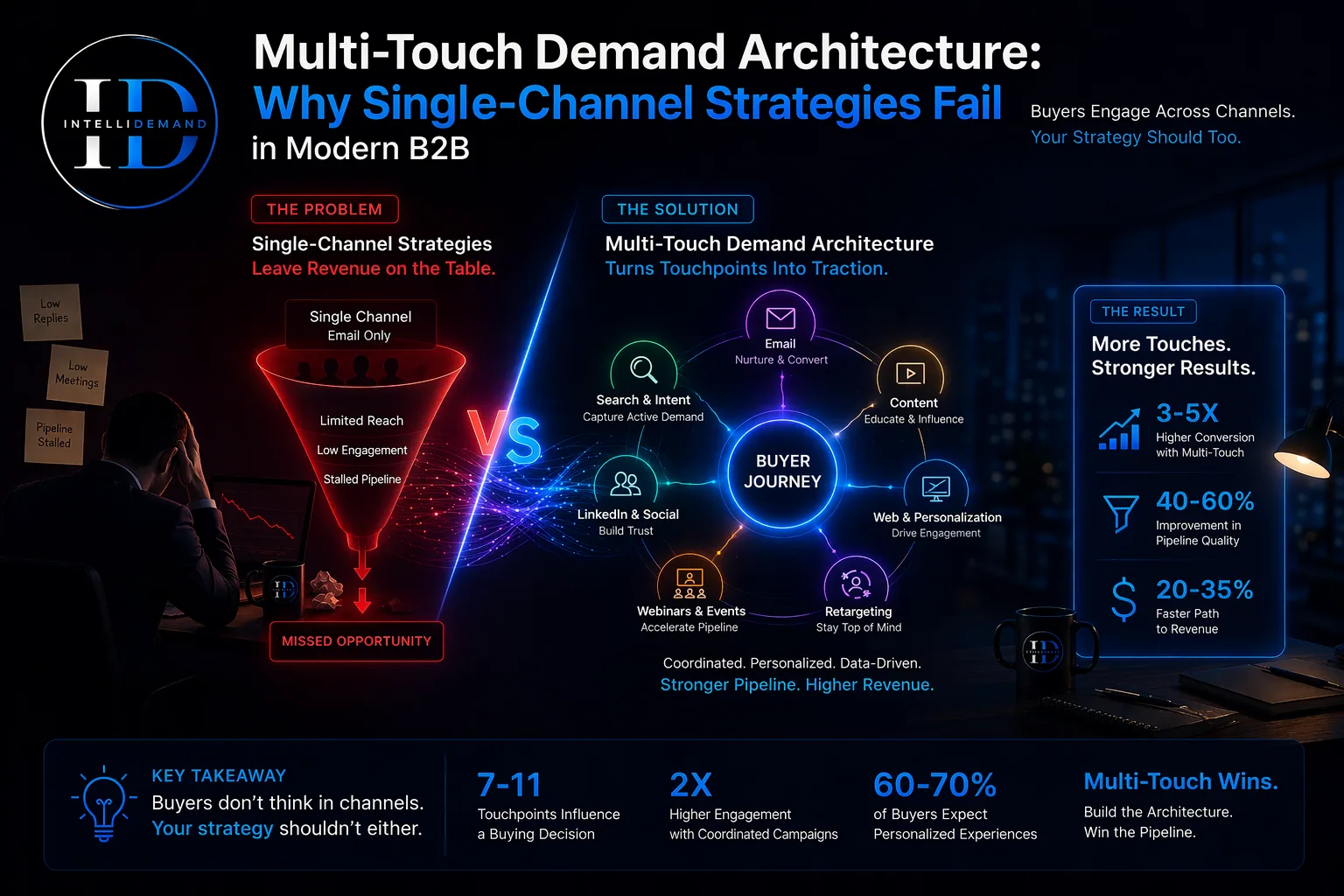
B2B buying has changed.
It is no longer linear.
It is no longer single-threaded.
And it is definitely not single-channel.
Yet many demand generation programs still rely on isolated tactics:
- One email campaign
- One content syndication push
- One paid media burst
- One SDR outreach sequence
This fragmented execution creates activity — not architecture.
And activity does not build predictable pipeline.
High-performance B2B organizations understand one critical truth:
Revenue doesn’t come from a single touchpoint.
It comes from coordinated influence across the entire buying committee.
Welcome to multi-touch demand architecture.
Why Single-Channel Strategies Collapse
Let’s start with reality.
The modern B2B buyer:
- Conducts independent research
- Engages multiple vendors simultaneously
- Involves 6–10 stakeholders on average
- Consumes 8–12 content assets before decision
Now ask:
Can one email convert that complexity?
Can one gated asset build consensus?
Can one ad drive enterprise commitment?
No.
Single-channel programs fail because they assume:
Interest = readiness
Engagement = intent
Response = opportunity
That assumption costs pipeline.
The Problem with “Campaign Thinking”
Traditional demand generation revolves around campaigns.
A campaign has:
- A start date
- An end date
- A target CPL
- A limited channel mix
But buying cycles do not operate on campaign timelines.
When marketing thinks in campaigns and buyers move in cycles, misalignment happens.
What high-performance teams build instead:
Demand infrastructure.
What Is Multi-Touch Demand Architecture?
It is a structured, coordinated system that:
- Engages multiple stakeholders
- Activates multiple channels
- Reinforces messaging across touchpoints
- Tracks account-level momentum
- Aligns with buying stage progression
It’s not about “more channels.”
It’s about orchestration.
The 5 Layers of Modern Demand Architecture
Elite B2B organizations design their demand engines across five synchronized layers.
Awareness Layer: Intent Activation
Before contact, buyers are researching.
Winning teams monitor:
- Topic-level intent signals
- Behavioral engagement data
- Account research spikes
- Industry trend alignment
Instead of blasting cold lists, they prioritize accounts already demonstrating buying curiosity.
This dramatically improves response quality.
Education Layer: Value Reinforcement
Once intent is identified, structured content engagement begins:
- Thought leadership
- Case studies
- Use-case frameworks
- Industry reports
- Executive insights
But not randomly.
Content is mapped to buying stage.
Early-stage buyers receive problem education.
Mid-stage buyers receive solution comparison.
Late-stage buyers receive validation proof.
This builds buying confidence.
Engagement Layer: Multi-Channel Outreach
At this stage, multi-touch orchestration becomes critical.
High-performance teams integrate:
- Email sequencing
- Account-based messaging
- SDR follow-up
- Retargeting ads
- Executive-level outreach
- Social reinforcement
Each touchpoint reinforces the same value narrative.
This creates familiarity and authority.
Validation Layer: Human Confirmation
Before pipeline handoff, qualification must validate:
- Initiative status
- Buying committee involvement
- Budget authority
- Timeline clarity
- Competitive landscape
This is where architecture protects sales time.
Without validation, pipeline becomes inflated noise.
Acceleration Layer: Sales Enablement Integration
Demand does not stop at meeting booking.
High-performing teams support sales with:
- Account research briefs
- Intent insights
- Stakeholder mapping
- Competitive positioning data
- Engagement history tracking
This improves:
- Discovery quality
- Opportunity conversion
- Sales velocity
Demand architecture continues influencing even after handoff.
The Buying Committee Reality
Enterprise buying rarely involves one person.
It includes:
- Economic buyer
- Technical evaluator
- End-user champion
- Procurement
- Executive sponsor
Single-contact programs collapse because they ignore committee dynamics.
Multi-touch architecture targets the account — not just the individual.
From Touchpoints to Momentum
Many programs measure touches.
But touches alone don’t matter.
Momentum does.
Momentum is visible when:
- Multiple stakeholders engage
- Intent increases over time
- Engagement depth rises
- Response quality improves
This is account progression — not isolated activity.
Technology Alone Is Not Enough
Marketing automation platforms promise orchestration.
But without strategic design, automation creates chaos at scale.
High-performance programs combine:
- Technology stack integration
- Data discipline
- Messaging alignment
- Sales coordination
- Continuous optimization
Automation amplifies strategy.
It cannot replace it.
The Revenue Impact of Multi-Touch Execution
When demand architecture is structured:
- Sales acceptance rates rise
- Opportunity creation improves
- Buying cycles shorten
- Win rates increase
- Pipeline predictability strengthens
When demand remains fragmented:
- Engagement is inconsistent
- Messaging is disconnected
- Follow-up is delayed
- Sales blames marketing
- Revenue fluctuates
Architecture creates consistency.
Consistency creates growth.
Why 2026 Demands Infrastructure Thinking
The next evolution in B2B demand is not:
More content.
More channels.
More volume.
It is:
More coordination.
More precision.
More accountability.
Organizations that treat demand as infrastructure — not activity — dominate competitive markets.
Final Thought
If your demand program relies on:
One channel
One tactic
One contact
One campaign
It is vulnerable.
Modern B2B growth requires multi-touch demand architecture designed to move entire accounts toward revenue.
Not just generate leads.
Because in enterprise demand generation:
Campaigns create noise.
Architecture creates pipeline.
Keep reading
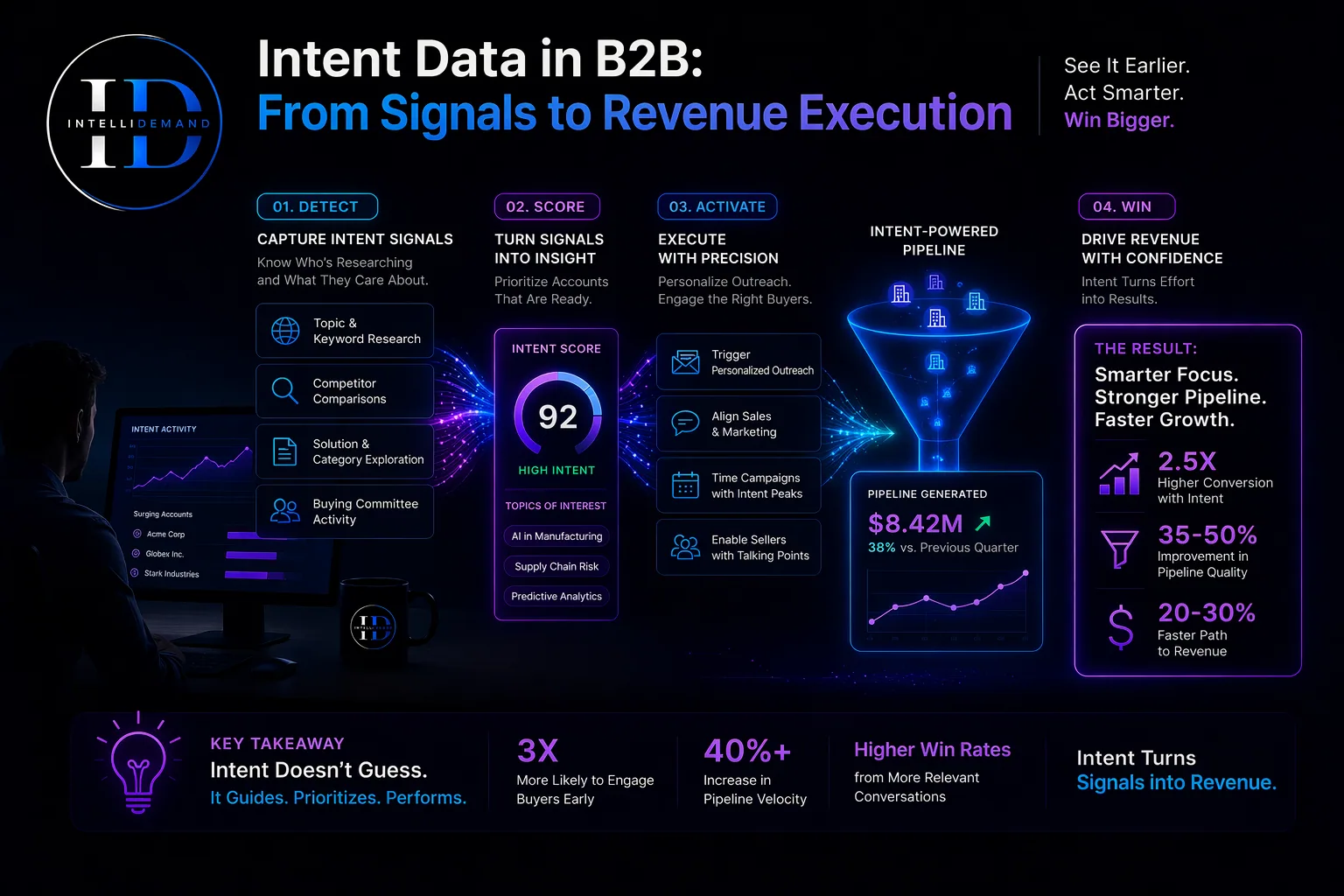
Intent Data in B2B: From Signals to Revenue Execution
Intent data has become one of the most discussed concepts in modern B2B demand generation. But discussion does not equal execution.
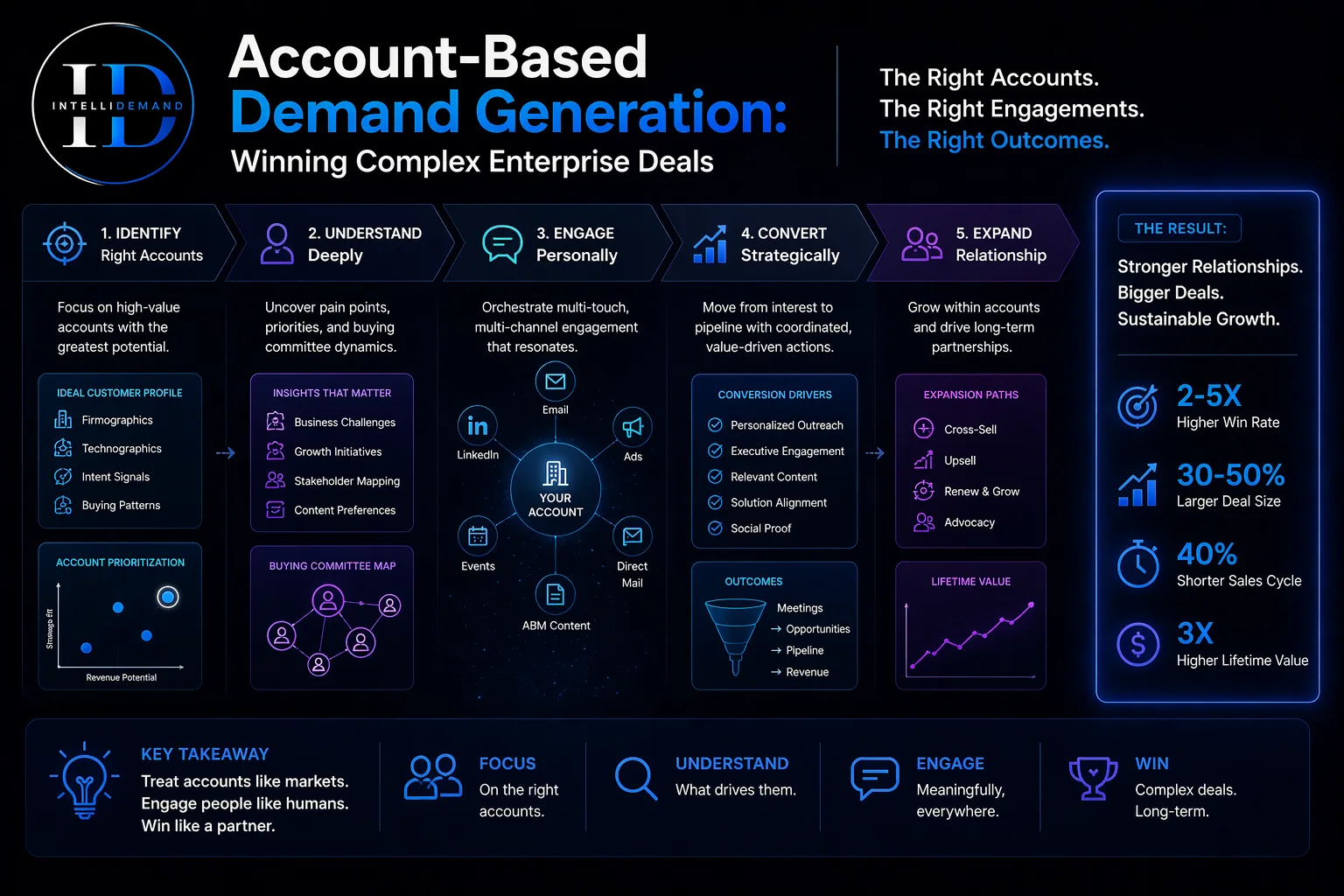
Account-Based Demand Generation: Winning Complex Enterprise Deals
Enterprise B2B sales are not won with broad campaigns. They are won with precision.
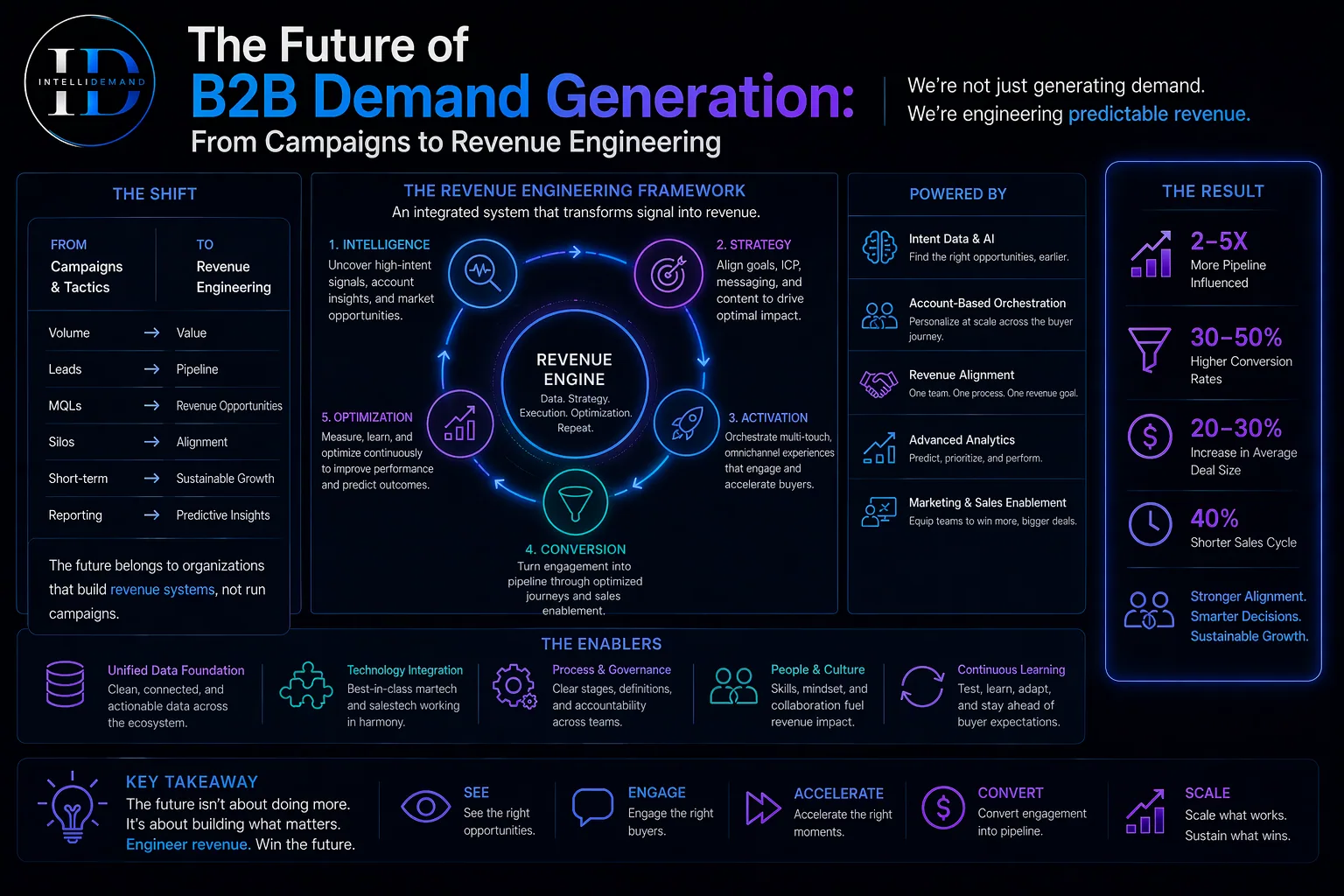
The Future of B2B Demand Generation: From Campaigns to Revenue Engineering
For years, B2B demand generation was campaign-driven. The future of demand generation is not campaign execution. It is revenue engineering.
Get demand-generation insights in your inbox
Practical B2B pipeline, ABM and content syndication ideas from the IntelliDemand team. No spam, unsubscribe anytime.